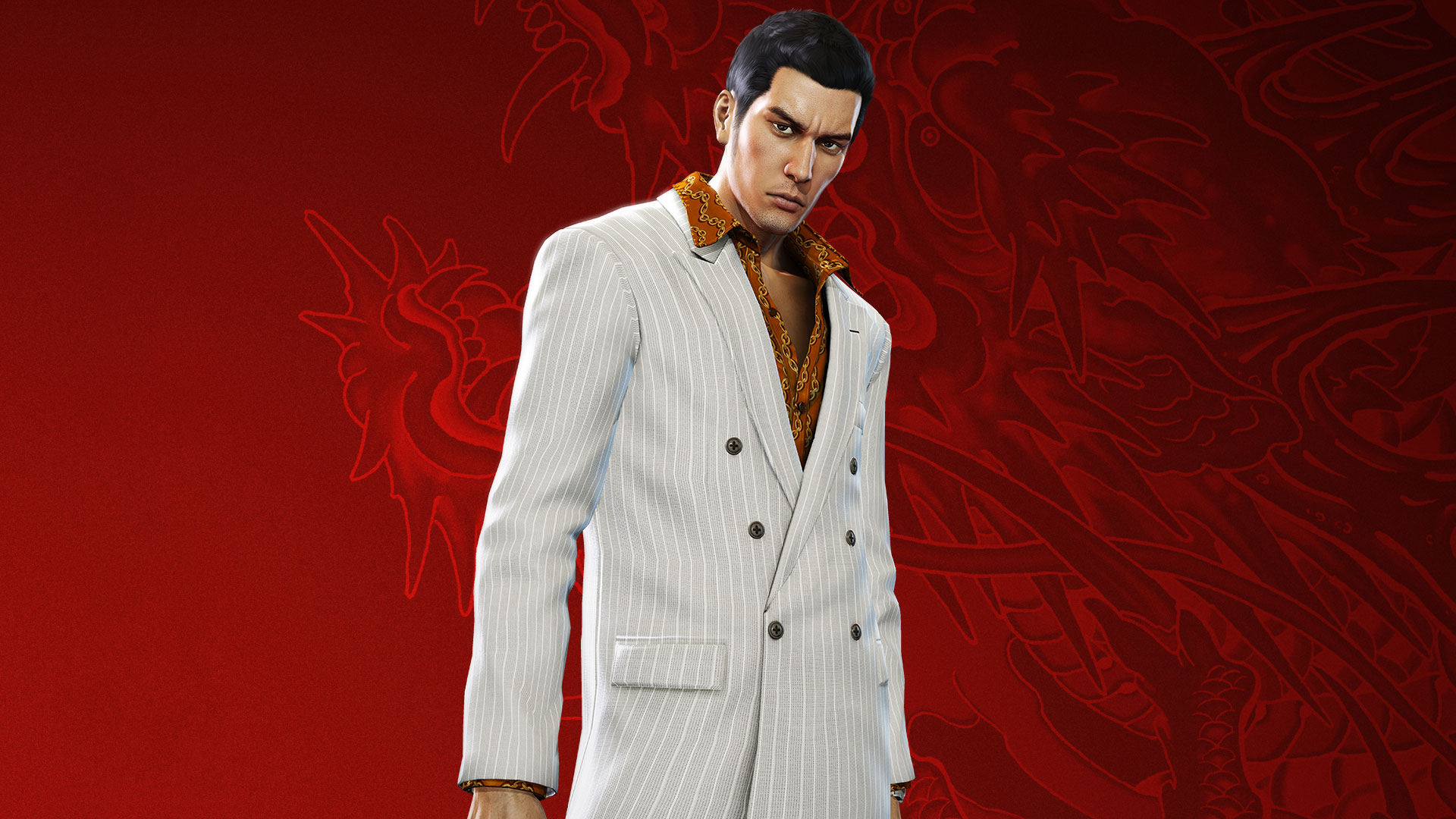
Welcome to the first of what I hope will be a casual ongoing series exploring autism in media. Or, rather, a lack of explicit autism in media, and how I craft it for myself. Each entry I’ll explore a character I read as autistic, and why I see autistic traits in a “non-autistic” character. This time we’ll be asking: Is Kiryu Autistic?
Before we start: though I support self diagnosis, I’m professionally diagnosed with autism. When I identify autistic traits in a character, it is not intended as a ‘diagnosis’ or a definitive answer. It is an idea from my own lived experience, and ‘diagnostic criteria’. I do not believe there is one singular experience of autism. I fully embrace that other autistic people can disagree with my interpretations. Each of us has our own experiences, because autism is a spectrum.
Who Is Kiryu Kazuma?
Kiryu is one of the main characters of the Like A Dragon franchise. He is front and center of the branding and the gameplay. He is a strong, independent brawler, a Yakuza chairman of the Tojo Clan, and a respected caregiver. Kiryu is probably the last person a corporation would intentionally write as autistic. We don’t get to be the hero of a wacky beat ’em up. We are sympathetic side stories, tragedy pieces.

Kiryu is also a face of masculinity. Frankly, he’s a sex symbol. Fictional autistic characters are usually men, but they are men seen as ‘lacking’ masculinity and definitely lacking sexuality. We are allowed, at best, to be ‘weak’ men with scientific special interests. His involvement in the Yakuza and time in prison also makes him a criminal. Again, media prefers to depict autistic characters as innocent children, morally pure and lacking agency.
So, Kiryu seems to be the antithesis of an autistic fictional character. Why do I read him that way then?
Emotions
My life often feels dominated by my emotions, and the ways my autism makes it difficult for me to deal with them. I struggle with alexithymia: difficulty in expressing and identifying my own emotions. A simplistic term for this is “emotional blindness”. This is extremely common in autistic individuals – often estimated as presenting in over 50% of autistics, as opposed to 10% of the general population. Although the struggle to identify your own emotions is an internal one, an inability to emote is a common autistic stereotype.
Kiryu fits this stereotype. His face is very un-emotive, and almost permanently set in an intimidating ‘scowl’. Although he very clearly does have emotions – grief at the death of his loved ones, for example – they rarely show particularly well on his face. Even when he is having fun, or intends to help, people assume he is angry because of his expression. This is something that has happened to me a lot.
Though he does not always express his emotion ‘obviously’, he still feels those emotions. In the right space he cries, he punches things in anger, and he laughs. His face is just less emotive than other people, and it really resonates with me.

Of course, as a very masculine character, Kiryu’s lack of emoting could be put down to societal expectations of men. Or, it could be caused by limitations of technology. Animating a face is difficult. But, even as the franchise has improved its graphics, Kiryu’s un-emotive face has remained constant enough to feel deliberate. Furthermore, he is not as bound by ‘manliness’ as you might expect. In his spin-off game he can wear make-up. The series places him as a sole caregiver for children again and again, and he displays unique awareness of gender’s social construction.
Literal Thinking
Similarly, Kiryu is bad at reading the emotions and social cues of others. He never seems to notice when he is being flirted with, or when he is being manipulated. Half of his side quest hijinks are caused by him taking people too literally or misunderstanding them. He needs to be told explicitly what to do, and when he’s expected to interpret or guess at his objective, he often guesses wrong.
In most LaD games there are ‘social interaction’ mini-games, where Kiryu can mess up and say something completely inappropriate. This is like a comical, hyperbolic representation of what social interaction feels like for me. A constant guessing game where I have to fumble for the right answer, dodging embarrassment, under an invisible timer.
In Yakuza 0 there’s even a quicktime event to present your business card correctly. The ‘social rules’ of the business meeting are also presented to Kiryu. You have to remember them and select the correct options during the meeting. This all implies that Kiryu cannot ‘naturally intuit’ social rules, that it all takes concentrated effort on his part, as it does for any autistic individual.
Special Interests

A special interest is hard and yet easy to explain. It’s a source of intense focus and emotion for autistics, literally something we take a special interest in. We can gather facts obsessively about these interests, revolve our entire lives around them, or show a general ‘unusual’ obsession with them. The way a special interest makes me feel is… At times it’s the only thing motivating me through the day.
Kiryu has a number of hobbies, but the standout one is usually agreed to be Pocket Circuit. Racing model cars involves collecting components, learning niche terminology and rules. In general, a lot of effort. When other people involve themselves in his hobby, Kiryu is unusually protective of it. He doesn’t want them ‘disturbing’ a place he can truly enjoy himself. Furthermore, it is seen as a ‘childish’ hobby. It’s fairly common for autistic special interests to center around something ‘childish’. In fact, this is one of the reasons they’re seen as a ‘problem’, supposedly limiting us.
Unlike hyperfixations, special interests often remain a permanent part of someone’s life. Over 40 years of his life, Kiryu shows a constant love for pocket circuit racing. The intense emotions it causes him are obvious. It’s one of the few things that causes his face to emote.

A Friend To The Outsiders
Kiryu regularly befriends and connects with people who are ‘outside’ the norm of society. Whether a lesbian hostess, a transgender barkeeper, homeless people, orphans, or even just “weirdos”. He shows extreme tolerance and doesn’t judge people based on whether they fit social norms.
This is very common in autistic people, who themselves often don’t understand or like those norms, and often fall outside of them in various ways. We understand what it’s like to be judged for not following invisible, culturally constructed rules. It’s easy to connect over a shared struggle to do just that with others. He comforts a lesbian hostess at one time, reassuring her that she shouldn’t “give up” on women just for an easier life.

Concluding
So, I can identify autistic traits in Kiryu… so what? Does that make him autistic representation?
Well, no. It’s very unlikely that there has ever been real intent to portray Kiryu as autistic. This doesn’t make him “Confirmed! The BEST Autistic Rep In Gaming!” or his autistic traits well-hidden easter eggs. It just means that I headcanon him as autistic because of my own biased experiences.
This reveals a strange trend with autistic ‘representation’. Often the best written autistic characters are characters the creator never intended to be autistic.
What this speaks to – and what I hope to demonstrate in this series – is that society’s view of autism is incredibly narrow. ‘Autistic traits’ vary wildly across the spectrum. Diagnosis usually hinges on whether these traits have a noticeable impact on your life, because there are plenty of neurotypical people who share some autistic traits and don’t even notice.
So, autistics can easily see traits that are a huge factor in their lives reflected in fictional characters. For me, identifying these traits gives me a huge boost, because outside of a highly medicalised setting, these traits are treated like good things. Kiryu’s “obliviousness” to social cues is endearing! His fascination with pocket circuit is fun! His unemotive face is iconic! People LOVE Kiryu. Seeing parts of your identity that people have rejected you for in a popular character can be a healing experience. It reminds you that those traits aren’t the problem, merely the cruel stigma attached to them in the “wrong” people.
For autistics, spotting autistic traits in their favourite characters is not about finding ‘secret representation’, but reclaiming agency and humanising themselves in a world that constantly tries to alienate them.
Leave a Reply